The best saree colour is the one that brings your face to life. Two women can try the same mustard Gadwal saree: on one it glows, on the other it looks dull. The saree is the same; what changes is the skin, hair and eyes next to it. Since 1998, at our shop in Gadwal, we have helped customers choose colours across the counter. This guide brings that experience together with simple colour principles, so you can choose online with more confidence.
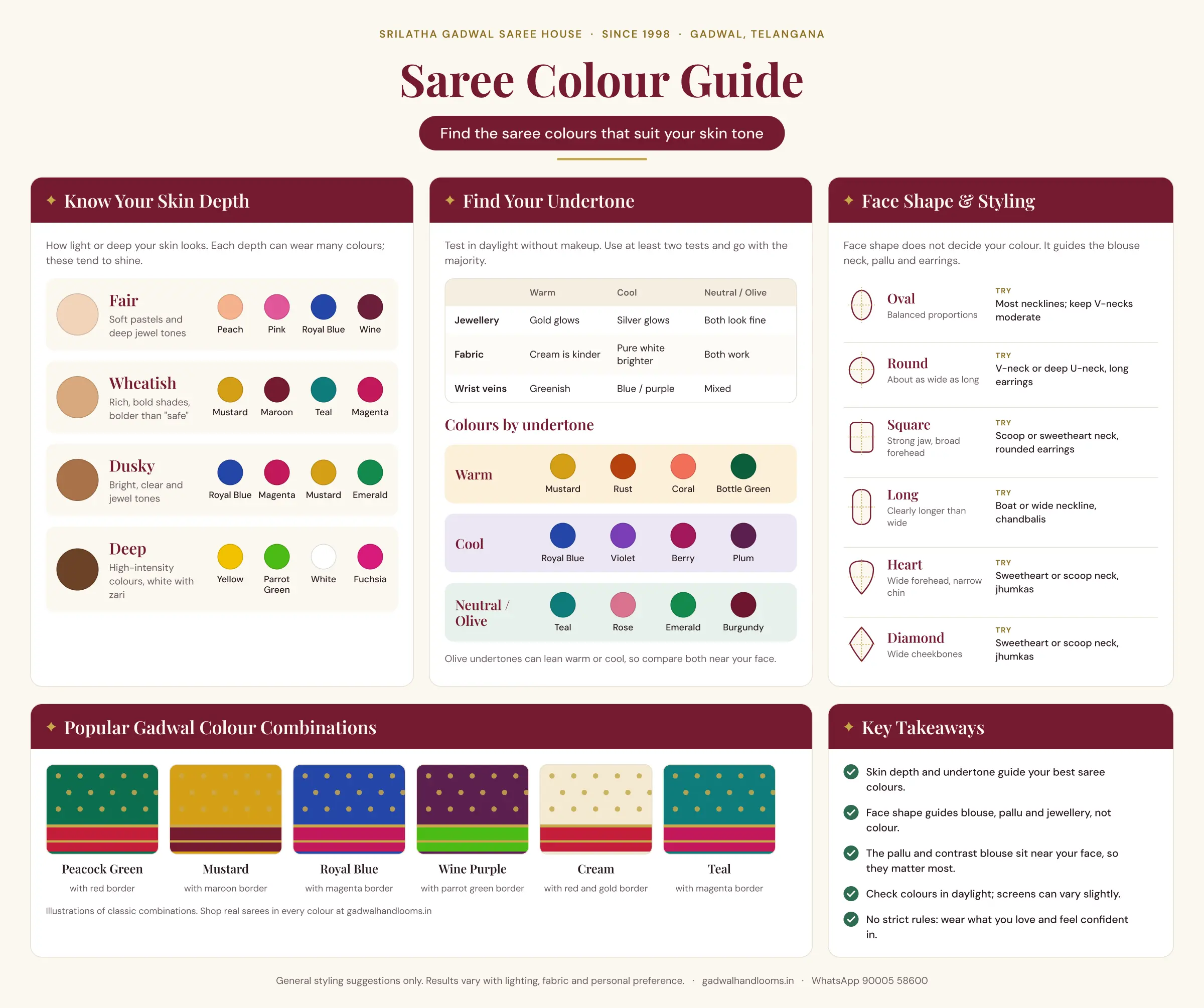
The 3 things that decide which colour suits you
Labels like fair, wheatish or dusky tell only part of the story. Colour stylists usually look at three separate things:
1
Depth
How light or deep your skin looks overall: fair, wheatish, dusky or deep. It guides how light or dark your saree can go.
2
Undertone
The tint beneath the surface: warm (golden), cool (pink), neutral (balanced) or olive (slightly green-grey). It guides which version of a colour suits you, such as tomato red or ruby red.
3
Contrast
How different your skin is from your hair and eyes. Higher contrast usually carries bold colour blocks; lower contrast often looks best in clear colours with zari.
Depth and undertone are different things. A deep complexion can be cool, warm, neutral or olive, and so can a fair one. Many Indian women have warm undertones, but certainly not all, so it is worth testing rather than assuming.
Find your undertone in about 2 minutes
Do these near a window in soft daylight, without makeup. Tube lights and yellow bulbs change what you see. Try at least two tests and go with the majority.
| Test | Warm | Cool | Neutral / Olive |
|---|---|---|---|
| Gold vs silver jewellery near the face | Gold looks more natural | Silver looks fresher | Both look fine |
| White vs cream fabric under the chin | Cream is kinder | Pure white is brighter | Both work; olive may look slightly grey in stark white |
| Tomato red vs ruby (blue-based) red | Tomato or coral red glows | Ruby or berry red glows | Both look balanced |
| Wrist veins (extra clue only) | Greenish | Blue or purple | Mixed or hard to tell |
No single home test is right for everyone. The most reliable check is simple: hold the actual saree or blouse fabric under your chin in daylight. A flattering colour usually makes skin look even and eyes look bright; a less flattering one can make the face look tired, yellowish or grey.
Saree colour chart at a glance
Find your skin depth on the left and your undertone across the top. These are the shades that, in general, tend to flatter that combination.
| Skin depth | Warm | Cool | Neutral / Olive |
|---|---|---|---|
| Fair | PeachMustardBottle GreenMaroon | Royal BlueWinePinkLavender | TealWinePinkNavy Blue |
| Wheatish | MustardMaroonBottle GreenOrange | MagentaRoyal BluePurpleWine | GreenTealWineMagenta |
| Dusky | MustardOrangeRedMagenta | Royal BlueMagentaGreenPurple | TealMagentaMustardGreen |
| Deep | YellowOrangeRedCream | WhiteRoyal BlueMagentaGreen | Parrot GreenYellowWhiteRoyal Blue |
Colour Finder
Want more detail, including colours to wear carefully and the right zari? Tap your combination below.
Saree Colour Finder
Pick your skin depth and undertone
Fair skin · Warm undertone
Soft colours glow on you, and deep warm shades give you a rich, regal contrast.
Your best saree colours (tap to shop)
Wear with a strong border or a contrast blouse
Fair skin · Cool undertone
Clear jewel tones and rosy shades make your skin look fresh; very yellow shades can make it look tired.
Your best saree colours (tap to shop)
Wear with a strong border or a contrast blouse
Fair skin · Neutral / Olive undertone
You can move between warm and cool. Medium-depth jewel tones are your safest wins.
Your best saree colours (tap to shop)
Wear with a strong border or a contrast blouse
Wheatish skin · Warm undertone
The most common Indian colouring. Earthy, spicy and rich shades bring out your golden glow.
Your best saree colours (tap to shop)
Wear with a strong border or a contrast blouse
Wheatish skin · Cool undertone
Berry and jewel shades suit you more than orange-yellow shades.
Your best saree colours (tap to shop)
Wear with a strong border or a contrast blouse
Wheatish skin · Neutral / Olive undertone
Choose colours that are clearly bolder than your skin. Shades that are too close to your skin look flat.
Your best saree colours (tap to shop)
Wear with a strong border or a contrast blouse
Dusky skin · Warm undertone
Bright, warm and saturated colours look stunning, and bright gold zari adds glow.
Your best saree colours (tap to shop)
Wear with a strong border or a contrast blouse
Dusky skin · Cool undertone
Cool jewel tones and crisp white with zari bring out the depth of your skin.
Your best saree colours (tap to shop)
Wear with a strong border or a contrast blouse
Dusky skin · Neutral / Olive undertone
Almost every clear, bright colour works. Avoid dull, greyish versions of colours.
Your best saree colours (tap to shop)
Wear with a strong border or a contrast blouse
Deep skin · Warm undertone
High-intensity colours and light cream with gold zari make the most striking contrast.
Your best saree colours (tap to shop)
Wear with a strong border or a contrast blouse
Deep skin · Cool undertone
Crisp white, cobalt-type blues and vivid pinks look spectacular.
Your best saree colours (tap to shop)
Wear with a strong border or a contrast blouse
Deep skin · Neutral / Olive undertone
Bold, clear colours are your best friends. Muddy shades too close to your skin hide your glow.
Your best saree colours (tap to shop)
Wear with a strong border or a contrast blouse
These are starting points, not rules. Hold the saree under your chin in daylight; the mirror always has the final say.
Real Gadwal examples by undertone
Warm undertones: sunlit, earthy colours
If golden, yellow or peach tones show in your complexion, try mustard, turmeric yellow, marigold, rust, terracotta, coral, tomato red, olive, bottle green and warm teal. Antique gold and copper zari can look especially rich.

Cool undertones: blues, berries and violets
If your complexion has a rosy or pink impression, try royal blue, cobalt, sky blue, indigo, plum, lavender, violet, berry, wine, ruby red, magenta and cooler emerald. Silver-toned jewellery may suit you, though gold can work well as a deliberate contrast.

Neutral and olive undertones: a wider palette
Neutral undertones usually have flexibility with both warm and cool shades: try peacock teal, jade, balanced red, rose, burgundy, emerald and plum. Olive undertones can be harder to read; test petrol blue, teal, olive green, plum, aubergine and dusty rose. Some olive complexions glow in earthy colours, others in cooler jewel shades, so compare them at your face.


Our sarees are one of a kind, so a pictured saree may sell out. Every colour in the chart above links to similar shades in stock.
Saree colours by skin depth
Fair
Both soft and deep colours tend to work. Deep jewel tones like wine, bottle green and royal blue give lovely contrast; pastels like peach, rose and lavender look graceful, especially with a darker border. Beige or pale cream very close to your skin can blend in, so choose those with a bold border or blouse.
Wheatish
A very common Indian complexion, often with a warm golden undertone. Shades that are a little bolder than feels safe usually work best: mustard, maroon, bottle green, teal, magenta and red. Plain beige or dull dusty shades near the face can make skin look flat.
Dusky
The old idea that dusky skin should avoid bright colours isn’t accurate. Mustard, magenta, royal blue, orange, emerald and gold often look radiant. Pastels can work too when they are clear, not greyish, and paired with a dark or zari border.
Deep
High-intensity colours often look stunning: sunshine yellow, parrot green, cobalt-type blues, fuchsia, and ivory or cream with bright zari. Very dark browns and dull olives close to the face can hide your glow unless lifted with zari.
There is no rule that dusky skin must wear only bright colours, or that fair skin must avoid deep ones. Your taste and comfort matter just as much as any chart.
Does face shape change which colour suits you?
In general, no. Which colour flatters you depends mostly on your skin, hair and eyes, not your bone structure. Face shape is useful for something else: how you place the colour near your face, through the blouse neckline, the border, the pallu and your earrings. These are optional ideas; wear the styles you love with confidence.
Find your face shape: tie your hair back, look straight into a mirror and compare the length of your face with its width, then look at your jaw and forehead.
Oval face
Slightly longer than wide, balanced features.
- Blouse: Most necklines work; keep V-necks moderate.
- Saree & pallu: Any drape and border width.
- Earrings: Jhumkas, studs or chandbalis.
Round face
About as long as wide, soft jaw, fuller cheeks.
- Blouse: V-neck, deep U-neck or sweetheart for a vertical line.
- Saree & pallu: Pallu in neat vertical pleats; slim to medium border near the face.
- Earrings: Long drop earrings or longer chains.
Square face
Strong jaw, broad forehead.
- Blouse: Round, scoop or sweetheart necks to soften angles.
- Saree & pallu: Curved motifs like butta or paisley near the face.
- Earrings: Rounded shapes: jhumkas, hoops, round chandbalis.
Long face
Clearly longer than wide, straight sides.
- Blouse: Boat neck, wide round neck or a wider square neck.
- Saree & pallu: Wider borders; pallu spread across the shoulder.
- Earrings: Earrings with some width, or a shorter necklace.
Heart face
Wider forehead and cheekbones, narrow chin.
- Blouse: Sweetheart, scoop or round necks.
- Saree & pallu: Medium borders; pallu pinned neatly on the shoulder.
- Earrings: Earrings fuller at the bottom, like jhumkas.
Diamond face
Wide cheekbones, narrower forehead and chin.
- Blouse: Sweetheart or scoop necks.
- Saree & pallu: Medium borders; soft, gathered pallu.
- Earrings: Earrings fuller at the bottom.
Styling and lighting tips from our shop
- The blouse is closest to your face. In a Gadwal saree, the border, pallu and contrast blouse (same colour as the pallu) sit near your face. If the body colour isn’t your best, a flattering pallu and blouse can tie the whole look together.
- Use the border for contrast. A contrasting Gadwal border adds definition. Notice how much of it shows near your face when the pallu is draped.
- Match zari to your undertone, loosely. Gold and antique gold zari usually warm the face; silver-toned zari suits many cool undertones. Neutral undertones can often wear both, and a deliberate contrast can look beautiful too.
| Setting | What usually happens | Good choice |
|---|---|---|
| Daytime function, daylight | Colours look true; soft shades show well | Pastels, clear brights, cotton and sico |
| Evening hall, warm yellow lights | Warm colours deepen; cool pastels can look dull | Rich reds, maroon, mustard, jewel tones with zari |
| Photos and videos | Very light colours can wash out; dark ones intensify | Medium-to-rich colours with zari |
| Shopping on a phone | Screens show shades slightly differently | Check details and ask us for more photos |
A colour can look different under different lights even when two fabrics match in one light; textile experts call this metamerism. Check a saree in daylight and, if possible, in the kind of light you will wear it in.
Your 4-step saree colour check
Notice your undertone with two or three tests in daylight.
Choose your contrast: soft and blended, or bold and striking.
Think about the occasion and the lighting there.
View the full look: body, border, pallu, blouse and jewellery together.
When a colour makes you smile and you feel comfortable in it, that is a very good reason to choose it.
Found your colours?
Every swatch in the chart and the Colour Finder opens matching Gadwal sarees. Unsure about a shade? Message us on WhatsApp at 90005 58600.
Shop Gadwal Sarees See the Colour ChartFrequently asked questions
Which saree colour suits Indian skin the most?
There is no single colour that suits everyone, because Indian skin ranges from fair to deep and can be warm, cool, neutral or olive. In our experience, maroon, a true red, bottle green or emerald, navy blue and gold zari tend to flatter the widest range of Indian complexions.
Which saree colours suit wheatish skin?
Wheatish describes skin depth, not undertone. Many wheatish women look lovely in mustard, maroon, bottle green, teal, magenta, coral and royal blue. Shades that are clearly bolder than your skin usually work better than beige or light brown worn close to the face.
Can dusky or dark skin wear bright colours?
Yes. Clear, saturated colours such as mustard, magenta, royal blue, parrot green, orange and ivory with zari often look striking on dusky and deep skin. Soft shades can look lovely too, especially with a contrasting border or blouse.
Does face shape decide which saree colour suits me?
Generally, no. Colour is mostly about your undertone, skin depth and the contrast with your hair and eyes. Face shape is more useful for choosing a blouse neckline, earrings, hairstyle and how you drape the pallu.
How do I find my skin undertone at home?
Try two or three simple comparisons in soft daylight without makeup: gold versus silver jewellery, white versus cream fabric, and a warm tomato red versus a blue-based ruby red near your face. Vein colour can be an extra clue. No single home test is accurate for everyone.
Can a person with a warm undertone wear blue or silver?
Absolutely. Undertone guides are suggestions, not restrictions. Try warmer blues such as teal or peacock blue, or wear blue as a contrast through the border, pallu or blouse.
If the body colour is not ideal for me, can I still wear the saree?
Yes. The colour closest to your face matters most. In a Gadwal saree the border, pallu and contrast blouse sit near your face, so choosing these in a flattering shade can make almost any body colour work for you.
Why does the same saree look different in photos and in real life?
Lighting, camera processing, screen settings, silk sheen and zari reflection all change how a colour appears. Product photos are a close guide, but the actual shade may vary slightly. Check sarees in more than one light, and message us if you would like more photos.
A note on the research
Personal colour analysis is a useful styling framework, not a fixed scientific rulebook. A 2021 study by researchers at the University of St Andrews found that observers consistently matched cooler hues to fair faces and warmer orange-red hues to tanned faces, which supports the idea that skin tone influences flattering clothing colours. However, it tested only 12 faces of White women, and the authors noted that stylists’ colour categories are not scientifically defined, so it should not be read as a formula for Indian women. A separate study of 1,204 women in four Indian cities documented how diverse Indian skin complexion is. Neither study prescribes saree colours, which is why the suggestions in this guide are practical starting points based on general colour principles and our shop experience.
Sources and further reading
- Perrett & Sprengelmeyer (2021), Clothing Aesthetics: Consistent Colour Choices to Match Fair and Tanned Skin Tones, i-Perception
- Hourblin et al. (2014), Skin complexion and pigmentary disorders in facial skin of 1204 women in 4 Indian cities, IJDVL
- AMANN: Understanding colour perception
- AMANN: Metamerism, when matching colours change under different light
This guide offers general styling suggestions only. Every person is different, and results may vary with lighting, fabric and personal preference. Saree colours on screen may differ slightly from the actual product. Product availability and prices may change.